Training
Effective Verbal De-escalation Skills for Private Unarmed Security Officers
The techniques our Officers train on to lower the temperature of a confrontation — positioning, tone, listening, and lawful, professional resolution.
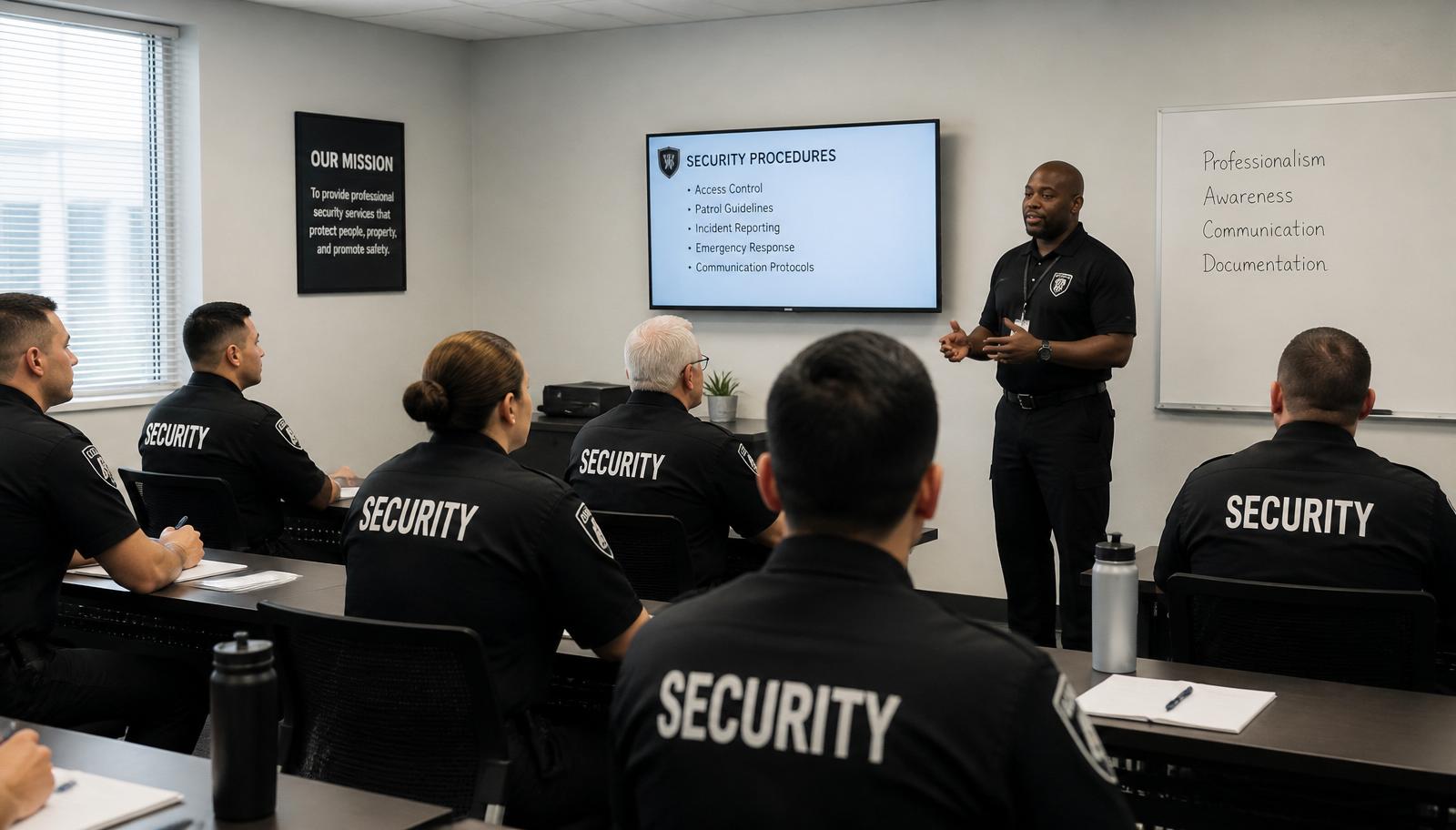
For an unarmed Officer, communication is the primary tool. Nearly every confrontation on a commercial or residential property — a trespass, an intoxicated guest, an angry former employee, a dispute between neighbors — is decided in the first ninety seconds by how the Officer speaks and where the Officer stands. De-escalation is not passivity. It is a trained discipline with a structure, and it is a core part of the Officer Integration Program (OIP).
Manage Yourself First
The Officer's own composure sets the ceiling for the encounter. Controlled breathing, a slower cadence, and an even volume all lower the emotional temperature. An Officer who matches a raised voice guarantees escalation; an Officer who stays measured gives the other person somewhere calmer to land.
Position and Distance
Stand at a slight angle rather than squared up, keep hands visible and open, and preserve a reactionary gap. Never block the only exit — a person who feels cornered fights. Give the subject an obvious, dignified way to leave, because a voluntary departure is nearly always the best outcome for the Client.
Listen Before Directing
Most confrontations are fueled by a person's belief that no one is listening. A brief, genuine acknowledgment — repeating back what the person is upset about — resolves a surprising share of contacts on its own. It costs thirty seconds and prevents the incident report nobody wants to write.
Give Clear, Lawful Direction
Once the temperature is down, direction should be simple, specific, and singular: one instruction, stated plainly, with the reason attached. Our Officers are trained on the limits of private security authority in Washington, so instructions are lawful and defensible rather than improvised.
Offer Choices, Not Ultimatums
Framing an instruction as a choice preserves the other person's dignity and their sense of control: leaving on their own, or waiting for law enforcement. People who keep their dignity generally take the exit offered.
Know When Words Are Finished
De-escalation also means recognizing when the conversation is no longer productive. At that point the professional move is to disengage, maintain observation from a safe distance, notify a Supervisor, and involve law enforcement. Our 24/7 Emergency Response line means an Officer in the field is never making that decision alone.
Document Everything
Every contact is written up: what was observed, what was said, what was directed, and how it ended. Whether the Officer is running Mobile Patrols in Pierce County, standing an On-site post in King County, or working Event Security in Snohomish County, the record is what protects the Client afterward.
Talk to a local security Team
Diligence Security protects commercial, industrial, and residential properties across the Puget Sound. Explore our Security services — from Mobile Patrols to Emergency Fire Watch — or see the Areas we serve. Ready to talk? Contact us for a site evaluation.